Werner Pfennig—Frederick
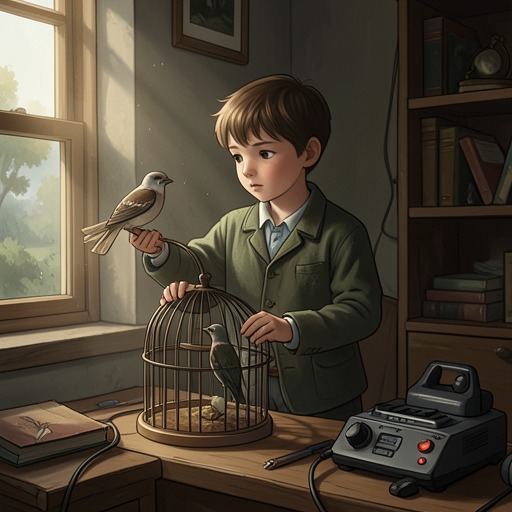
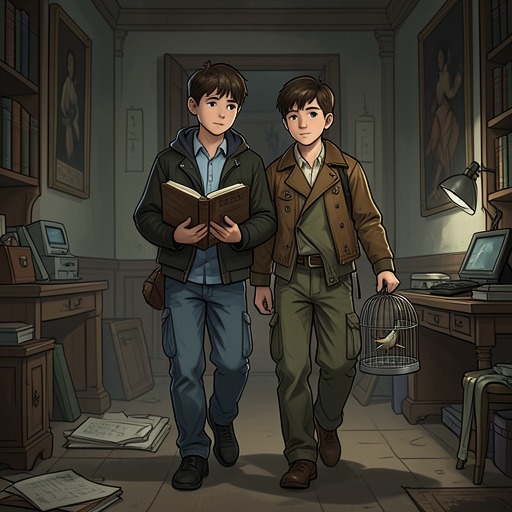
All the Light We Cannot SeeWerner Pfennig and Frederick’s friendship begins in the dormitory at Schulpforta and becomes one of the most intimate measures of Werner’s moral failure there. Their bond is made in small acts of companionship and a shared life among the cadets, but it is tested when Frederick is singled out for punishment and Werner does nothing to stop it. Even after Frederick is left unable to remember him, Werner’s attention returns to the friend he failed and to the birds that had given Frederick a world beyond the school.
Meeting at Schulpforta
Werner and Frederick are both new cadets, fourteen years old, sharing a cramped dormitory with six other boys their age. Frederick sleeps in the bunk above Werner. He is slender and pale, newly arrived from Berlin, where his father works as an assistant to an ambassador. From the beginning, his attention seems to wander beyond the immediate scene: when he speaks, he can seem to be searching the sky. Their first meal together, in stiff new uniforms at a long table in the refectory, marks the start of a friendship Frederick anticipates more readily than Werner does.
Frederick approaches Werner through birds. He asks if Werner likes them, then explains that hooded crows can solve problems by placing hard-to-crack nuts in the road and waiting for cars to break them. His account is not merely a lesson in animal intelligence: it shows the attentiveness and curiosity that distinguish him from the school’s insistence on discipline and certainty. Frederick declares that he and Werner will be great friends. Werner does not answer with the same confidence, but their shared room gives that confidence time to take root.
A friendship made of routines
Their closeness develops through practical, repeated gestures. Werner washes Frederick’s mess tin, shares homework answers and shoe polish, and gives him sweets obtained from Dr. Hauptmann. They run side by side during field exercises. These acts establish an everyday reciprocity: the friendship is not expressed chiefly through declarations, but through Werner’s willingness to make the demands of cadet life easier for Frederick and to stay near him within it.
Their difference in attention remains part of the bond. Werner’s mind is increasingly occupied by Dr. Hauptmann’s transceiver and the technical work that may shape his future; Frederick is drawn to birds, observing and identifying them with unusual skill. When older cadets fire into trees to scatter or kill the birds, Frederick watches the disturbance and says, “I hate them. I hate them for that.” His response reveals both his attachment to living things and his aversion to the casual violence around him. Werner’s companionship places him beside Frederick, but it does not yet mean he can defend what Frederick cares about.
The “weakest” trials and Werner’s silence
The friendship is placed under its most severe strain by Schulpforta’s field exercises, in which an instructor makes the boys identify and pursue the cadet considered weakest. When Helmut Rödel names Frederick, Werner feels the choice as a blow. Frederick is sent across the snowy field while the others chase him. The first time, his pursuers catch him fifteen strides from Bastian. Werner is there among the cadets, but cannot make himself intervene as Frederick is punished.
The pattern recurs three times in nine days. Frederick must run several hundred yards, often through deep snow; each time the boys catch him, and each time Bastian oversees his punishment. Frederick endures fewer blows before falling as the episodes continue, yet he does not cry out or ask to leave. The trials expose a sharp contrast between the friends: Frederick’s quiet refusal to plead does not release him, while Werner’s awareness of the injustice does not become action. Werner remembers Frederick as someone who can walk for hours in the woods and identify warblers from their calls at a distance, and thinks of him as stronger than himself in every imaginable way. At the moment when that strength needs an ally, Werner opens his mouth and closes it again.
Werner’s failure is not presented as a disagreement that Frederick names or settles. Frederick never accuses him of betrayal, despite Werner’s inaction during the beatings and afterward. During January recess, bruised and moving slowly, Frederick invites Werner to visit him in Berlin and meet his mother. The invitation preserves the possibility of friendship without pretending the school’s violence has not altered it. Werner’s guilt remains his own: he neither confronts Rödel nor challenges Bastian or demands justice from Dr. Hauptmann.
What Frederick believes about choice
The friends’ conversations also bring into focus their different hopes and their unequal sense of freedom. Werner wants to become an engineer; Frederick imagines studying birds, like the American painter associated with the swamps. When Frederick asks why they would endure their work otherwise, his question sets personal aspiration against the institution’s efforts to determine what its cadets will become. He tells Werner, “Your problem, Werner, is that you still believe you own your life.” The remark gives their friendship a painful clarity: Frederick can see Werner’s attachment to a chosen future even as Werner is being trained to accept a future chosen for him.
Frederick’s birdwatching makes that belief tangible. He points out a gray wagtail and remarks on the small bird’s ability to fly to Africa and back, sustained by insects, worms, and desire. For Werner, who is drawn to engineering and radio, the bird is also a figure for a life not wholly confined by the school’s walls. Yet Frederick’s own freedom is sharply limited. A new cadet takes the bunk above Werner’s, while Werner watches the familiar sleeping place and hears the trains moving east toward the front. Frederick’s absence from the daily room is thus both personal and institutional: Schulpforta continues to fill its beds and move its boys onward.
The visit and the broken recognition
After Frederick has been removed from Schulpforta, Werner visits him in Berlin shortly before Werner himself is to be sent to the front. Frederick’s mother warns that he will not recognize his former friend and that attempts to make him remember will upset him. She nevertheless allows Werner to see him. Frederick is being cared for by Franny, and his mother’s greeting carries troubled affection as well as uncertainty about Werner’s connection to what has happened. The scene makes plain that Werner has returned to a friendship whose ordinary forms cannot simply be resumed.
Werner introduces himself as Frederick’s school friend. Frederick looks toward him through smudged lenses, but the exchange does not restore recognition. Werner tells him that he is leaving Schulpforta and that the school is changing his age and sending him to the front. Frederick responds with words meant for his mother, calling Werner pretty and addressing him as Mama. Werner corrects him, but Frederick’s expression gives no sign of deliberate rejection; the words instead show the distance between their shared past and Frederick’s present condition. Werner’s account of the visit turns to the blue walls and to images from Birds of America—heron, warbler, tanager—while he cannot bear to look into Frederick’s vacant, unfocused gaze.
The relationship therefore ends without a mutual farewell. Frederick does not remember Werner, while Werner retains the knowledge of their friendship and the burden of what he failed to do for it. At Schulpforta, Werner had pictured Frederick with a book of birds, freeing birds trapped on its pages; later, alone in the laboratory, Frederick’s image returns among Werner’s memories of the mines, Jutta Pfennig, and the signals he searches for on the radio. That recurrence gives the friendship a continuing presence even when direct communication has become impossible. Frederick’s attentiveness to birds and his refusal to accuse Werner survive in Werner’s memory as an alternative to the school’s demanded obedience—and as a measure of the courage Werner did not show when his friend needed him.